
Technical Insights
Why Vacuum, Not Mixer Speed, Removes Air from High-Solids Paste
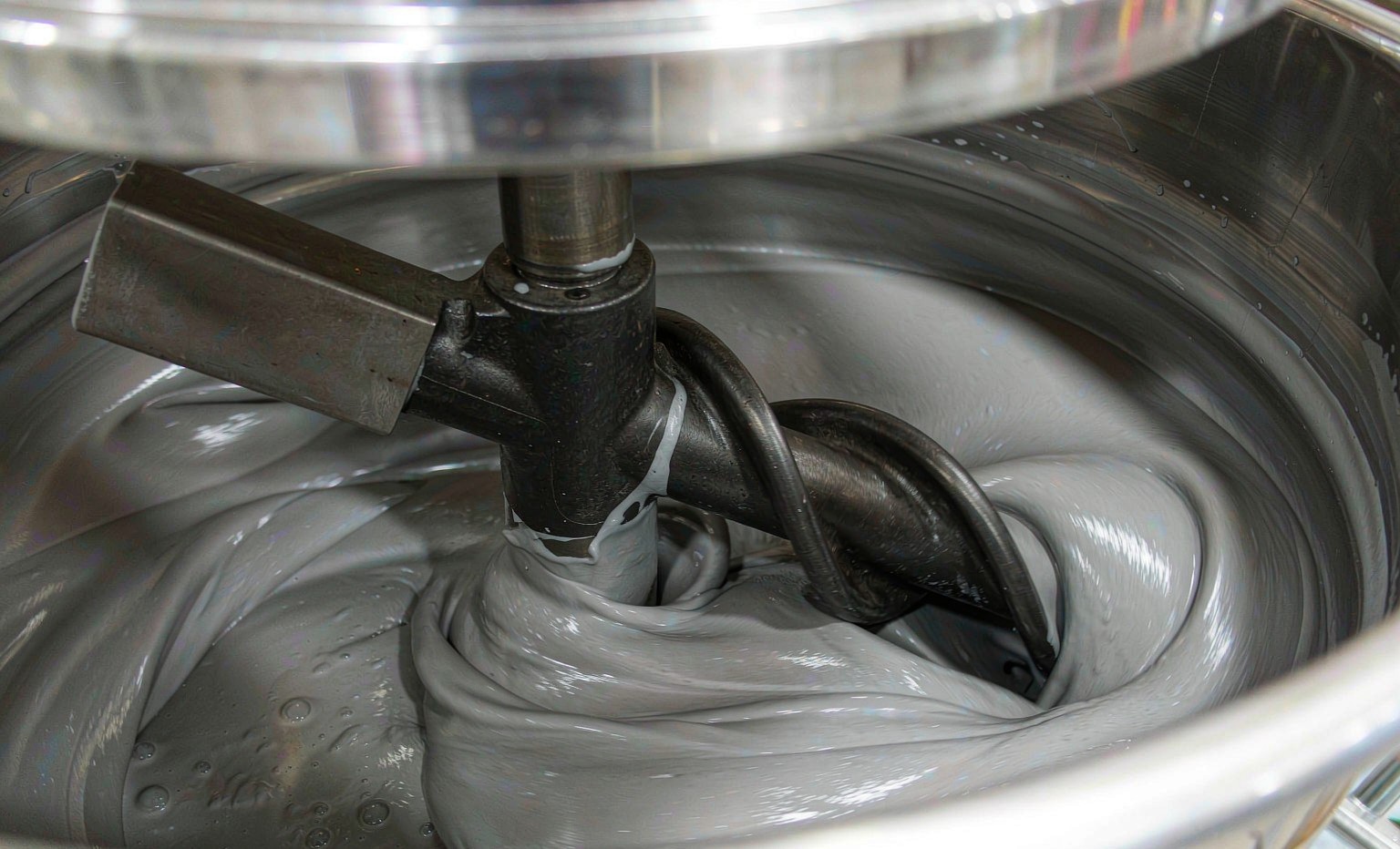
Every high-solids paste carries air. Most of it arrives with the powder, some is folded in by the blades, and a little more enters during discharge. No combination of blade geometry and shaft speed will take it out again — which is why the vacuum system, not the drive, is the part of a planetary mixer that decides whether the product is acceptable.
This is not a controversial claim inside the industry, but it is routinely under-specified at the quotation stage: customers compare kilowatts and litres, and the vacuum pump becomes a line item. Here is what the physics says about why that ordering is backwards.
1. Three routes for air to get in
- Powder wetting. A high-surface-area filler — carbon black, fumed silica, conductive metal powder — arrives with air adsorbed on the particle surface and packed in the voids between particles.
- Folding. Planetary blades turn the paste over rather than throwing it, so they entrain air at the free surface and bury it in the bulk instead of releasing it.
- Transfer. Pumping, pouring or pressing the batch out of one vessel and into another re-enters air at every free surface it passes.
2. Why a faster blade makes it worse, not better
A bubble rises because it is buoyant, and its rise speed follows Stokes’ law: velocity scales with the square of the bubble diameter and inversely with viscosity. Take a 1,000 kg/m³ density difference, a 50 Pa·s paste and a 100 µm bubble — and the bubble travels on the order of 0.4 mm per hour. From the middle of a 500 mm deep vessel, that is measured in weeks.
Turning the disperser up does not fix this. Higher tip speed adds shear, and shear breaks large bubbles into smaller ones. Since rise speed depends on the square of diameter, halving a bubble makes it four times slower to escape. Over-mixing a deaerated batch can therefore put air back into suspension while appearing to work harder.
3. What vacuum actually does
Reduce the pressure above the paste and the trapped bubble expands — at half an atmosphere a bubble doubles in volume, and its buoyancy rises with the cube of its diameter while its drag rises only with the square. The net effect is a large increase in rise speed, plus a mechanical effect that matters just as much: as the bubble grows it pushes paste aside, breaking the film that was pinning it to the blade or the wall. Air dissolved in the vehicle also comes out of solution once the partial pressure drops below its saturation value.
In practice the vessel is sealed, vacuum is pulled while mixing continues, and the batch is held at the set point until the gauge stops moving. Every Ruijing planetary mixer ships with a Panasonic digital vacuum gauge as standard, and a PT100 sensor in the material, so the end point is a reading rather than an elapsed time.
4. Why the wall scraper matters for deaeration
Vacuum only acts at the free surface. In a 50,000 cP paste almost none of the batch is at the free surface at any moment, so the surface has to be renewed continuously. The scraper arm that turns with the planetary carrier drags material off the vessel wall and the bottom and feeds it back into the blades, which is what keeps exposing fresh paste to the vacuum instead of leaving a static skin on the wall. The vessel bore is machined for exactly this reason — a scraper that leaves a film behind leaves air behind with it.
5. Temperature is part of the vacuum design
- Every frame uses a double-wall vessel with an internal deflector groove, circulating cooling water or heat-transfer oil.
- Heating is capped at 200 °C. Above 60 °C the vessel needs an external insulation blanket, which has to be specified with the order rather than added later.
- Under vacuum, volatile components evaporate at a lower temperature, so the jacket is often doing cooling work during deaeration even when the recipe is nominally a hot mix.
- Temperature is read from the material by PT100, not from the jacket, because the two separate during a long vacuum hold.
6. Tip speed by frame size
Dispersion energy is set by tip speed rather than shaft rpm, and the published figures for the standard frames scale with vessel diameter:
| Frame | Disperser tip speed | Notes |
|---|---|---|
| 2 L – 10 L | 8.37 – 10.5 m/s | Grouped figure published for the small frames |
| 20 L / 30 L / 50 L | 11.9 / 14.7 / 15.1 m/s | Per model |
| 100 L / 200 L | 18.84 / 20.5 m/s | Per model |
| 300 L / 500 L / 650 L / 1,000 L | 21 / 23 / 23.2 / 23.6 m/s | Per model |
Tip speed is a maximum at the stated disperser speed. Vacuum level is set by the process, not fixed by the machine.
7. What to measure in a trial
- Leak-down rate, with the vessel empty and then with a representative batch — the second number is the one that matters.
- Whether the batch foams or simply releases bubbles. Foaming means the vacuum is being pulled too fast for the solvent system, not that the pump is undersized.
- Time to a stable gauge reading at the intended mixing speed, at two batch sizes if possible.
- Whether discharge is also under vacuum. A perfectly deaerated batch can pick air back up in the last thirty seconds.
Fighting pinholes, voids or inconsistent density?
Send the formulation, solids loading and the defects you are seeing. We will advise on vacuum staging, jacket temperature and the frame size that gives the paste enough surface renewal to deaerate in one hold. Ask for a process review ›
Direct Factory Engineering
Inquire About RJ-VPM Series
Need custom pilot trials or gigafactory scale quotation? Speak directly with our mixing engineers.