
Technical Insights
Mixing and Discharging in One Frame: Cutting the Transfer Step for High-Viscosity Paste
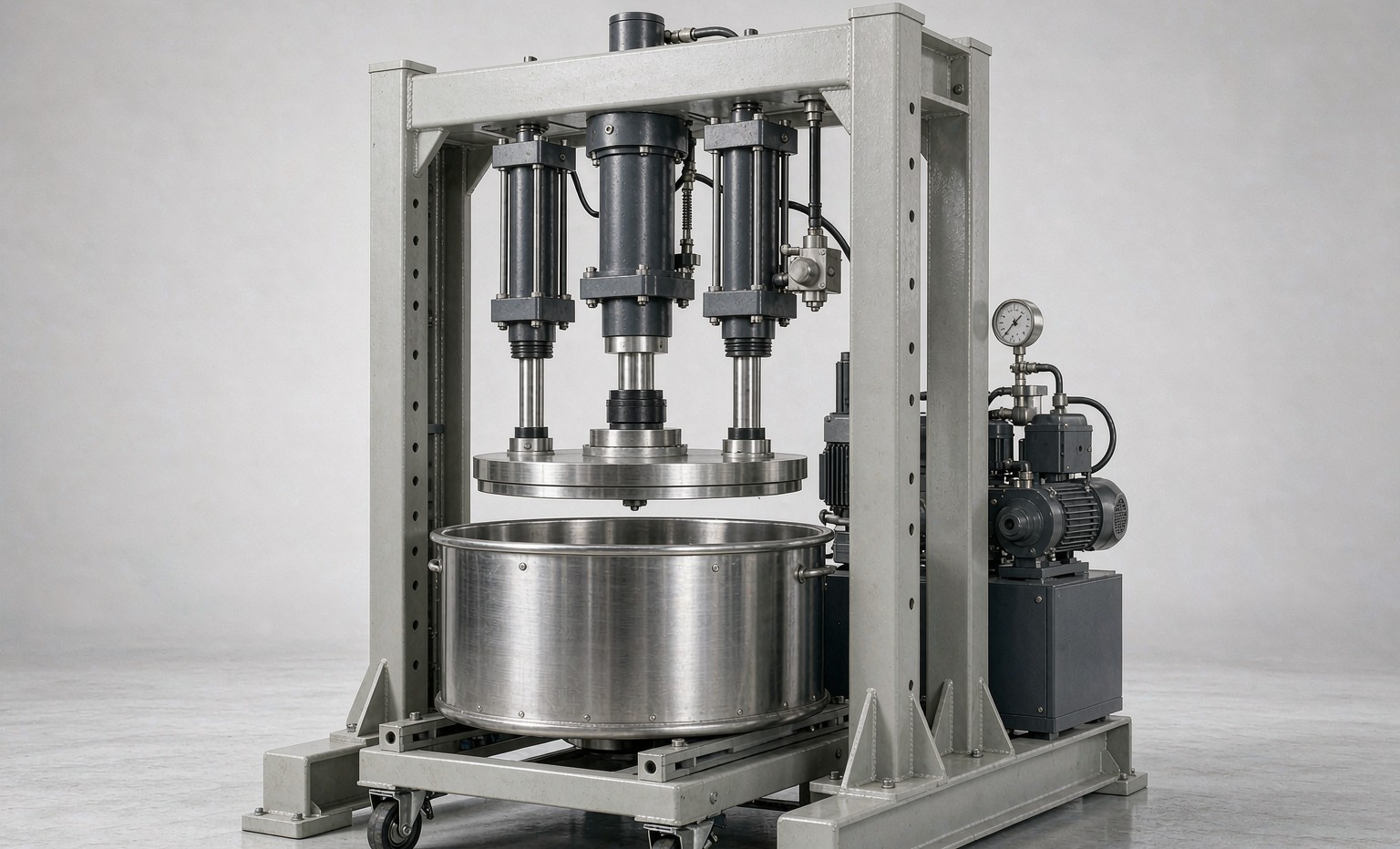
Between mixing and packing there is usually a transfer: paste out of the mixer, into a container, then into a press. Each of those steps costs yield, adds air, and has to be cleaned. For high-viscosity compound the transfer is often the least controlled part of the whole process — which is why Ruijing builds both an integrated mixer-discharge format for small batches and standalone presses for the larger vessels.
The two are the same idea at different scales: a pressure plate that descends into the vessel, seals against the wall, and pushes the batch out through the bottom instead of asking it to flow on its own.
1. What a transfer actually costs
- Residue. Thick paste does not drain. Whatever clings to the mixer wall is either scraped out by hand or lost.
- Air. Every free surface the batch passes re-entrains air that the vacuum hold just removed.
- Solvent. An open transfer is an evaporation step, and the viscosity at packing is not the viscosity that was approved.
- Cleaning. Two machines to clean instead of one, with the same product in both.
2. The integrated format, 2 L to 20 L
On the small frames the press is built onto the mixer rather than beside it. The vessel that was mixed under vacuum is the vessel that gets pressed, so there is no intermediate container and no second free surface. Front discharge is standard, control is touchscreen with PLC, and the discharge cylinder runs at 7 MPa from a vane pump. Standard frames are 2 L, 3 L, 5 L and 20 L, and an explosion-proof variant is available on the 5 L frame for solvent-bearing systems.
3. Standalone presses for 200 L and 300 L
Above the integrated range the press becomes a separate machine that serves a mixer vessel. The 300 L and the 55-gallon / 200 L units share the same hydraulic architecture:
- Hydraulic pressure adjustable in stages anywhere from 0 to 20 MPa, with the piston rod able to hold at any position.
- Continuous operation under holding pressure, so the batch can be pressed slowly rather than in one stroke.
- A rubber ring on the pressure plate seals against the vessel bore, so material cannot back-flow past the plate and the vessel drains completely — an optional vacuum deaeration kit can be fitted to the plate.
- The pressure plate assembly is raised hydraulically to the top of the frame for cleaning and vessel changes.
The current design lifts the vessel from both sides with a pair of hydraulic cylinders rather than lifting only the plate. That allows the vessel to be stopped at any height within the stroke, which makes loading and unloading a two-person job into a one-person job, and it lowers the overall frame height — the machine fits through a standard door and travels on a normal truck.
4. Choosing between the two
| Requirement | Integrated unit (2 – 20 L) | Standalone press (200 / 300 L) |
|---|---|---|
| Typical batch | 2 – 20 L per charge | One full mixer vessel, 200 or 300 L |
| Discharge pressure | 7 MPa, vane pump | 0 – 20 MPa, adjustable in stages |
| Vessel | The mixing vessel itself | Separate vessel, lifted by two cylinders |
| Control | Touchscreen + PLC, front discharge | Hydraulic, pressure-plate sealing |
| Solvent systems | Explosion-proof variant on 5 L | Vacuum deaeration kit optional on the plate |
| Best fit | Pilot runs, sampling, small production | Production batches and bulk packing |
Non-standard vessel interfaces, plate diameters and discharge formats are quoted against the drawing.
5. Three questions before specifying
- What is the vessel interface? Plate sealing depends on the bore being round and consistent, so the press and the vessel are usually specified together.
- How is the batch packed — bulk into a drum, or portioned into cartridges? The answer decides whether the press needs a follower plate, a bottom valve or a filling head.
- Is the paste solvent-bearing? If so, the explosion-proof route affects the motor, the wiring and the control enclosure, and is cheaper to specify at the start than to retrofit.
Emptying a high-viscosity batch without losing it?
Send us the vessel drawing, batch weight and packing format. We will confirm whether an integrated unit covers the batch or whether a standalone press is the better match. Request a discharge review ›
Direct Factory Engineering
Inquire About RJ-VPM Series
Need custom pilot trials or gigafactory scale quotation? Speak directly with our mixing engineers.