
Company News
Ruijing Releases Technical Data for 200 mL-10 L Laboratory Planetary Vacuum Mixers
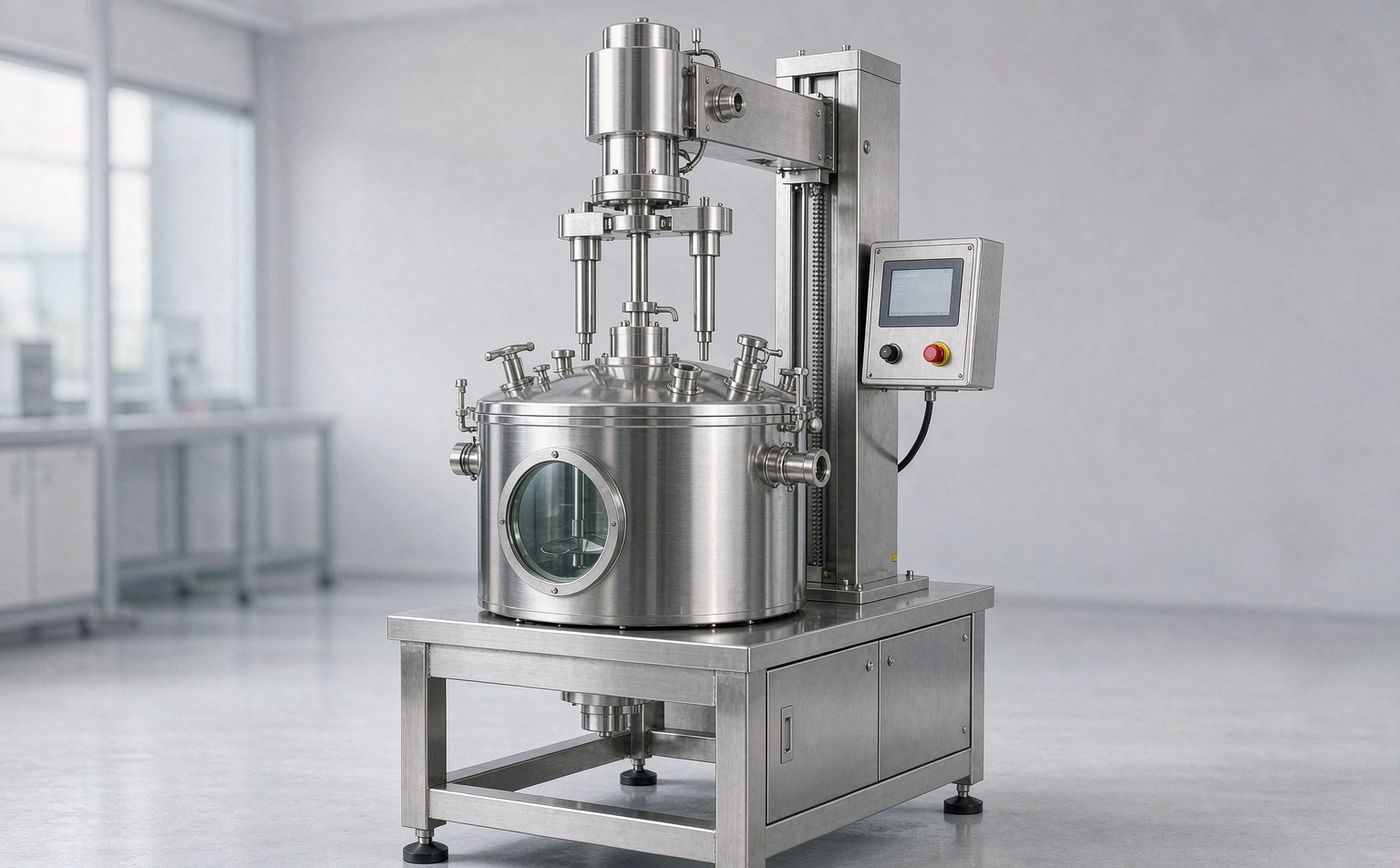
Ruijing has released the confirmed technical data for its RJ-JBC laboratory and pilot planetary vacuum mixers — one platform now documented from a 0.3 L benchtop unit up to a 14.1 L floor-standing frame, using the same dual planetary mixing principle as the company’s production-scale cells.
For formulators working on conductive adhesives, solder paste, battery slurry or electronic pastes, the difficult step is rarely the production run — it is proving the formula on a batch small enough to iterate, on hardware that still behaves like the machine that will eventually make it.
1. Seven batch sizes, one mixing kinematics
Every RJ-JBC frame runs two planetary blades that orbit the vessel while rotating on their own axes, paired with a scraper arm that turns with the planetary carrier. From 0.5 L upward an independent high-speed disperser shaft is added on a separate drive, so dispersion and planetary kneading can run at different speeds instead of compromising on one.
The 0.2 L unit is the exception: a benchtop frame with a 200 W stirrer at 150 rpm and no separate disperser, aimed at gram-scale screening where a full dispersion shaft would be over-specified.
2. Dispersion energy scaled to the batch
Tip speed, not shaft rpm, is what a paste actually experiences. The published linear speeds run from 7.85 m/s on the 0.5 L frame to 10.5 m/s at the top of the range, with the disperser turning at 5,000 rpm on the 0.5 L and 1 L units and 4,000 rpm from 2 L upward. The planetary stirrer stays at 150 rpm across the series, which keeps the wall-scraper geometry and the kneading action consistent between sizes.
3. Vacuum, temperature and contact parts
- PT100 sensing of material temperature on every model, with a Panasonic digital vacuum gauge as standard.
- Double-wall vessel for cooling water or heat-transfer oil, with an internal deflector groove; heating is capped at 200 °C.
- Above 60 °C the vessel requires an external insulation blanket, which has to be specified with the order.
- Twist blades are die-cast in one piece with no welded joints, preserving blade profile and cleanability; a folding version is optional for narrow vessel openings.
- Vessels can discharge from the bottom or the front. The 200 mL to 1 L frames have no discharge port — the vessel is lifted out, or emptied through a discharge press.
4. Control and handling
All models ship with touchscreen HMI and PLC control plus variable-frequency drives, so stirrer and disperser speeds are set independently and a recipe can be repeated rather than re-learned. The self-rotating wall scraper runs at 68–75 rpm. Lift is by electric screw on the 0.2 L to 10 L frames; hydraulic lifting starts at 300 L. The smallest frame occupies 500 × 470 mm of floor and weighs 200 kg, while the 10 L unit measures 1,230 × 830 × 1,695 mm at 640 kg. Frames up to 1 L run on single-phase 220 V; from 2 L the machines are three-phase 380 V.
5. Published specifications
The tables below reproduce the confirmed data for the seven standard frames. Non-standard vessels, explosion-proof configurations and alternative contact materials are quoted separately against the process requirement.
Mixing performance
| Model | Design volume | Stirrer | Disperser | Tip speed |
|---|---|---|---|---|
| RJ-JBC-0.2L | 0.3 L | 200 W @ 150 rpm | none | — |
| RJ-JBC-0.5L | 1.13 L | 400 W @ 150 rpm | 750 W @ 5,000 rpm | 7.85 m/s |
| RJ-JBC-1L | 1.95 L | 400 W @ 150 rpm | 750 W @ 5,000 rpm | 9.15 m/s |
| RJ-JBC-2L | 3.05 L | 1.1 kW @ 150 rpm | 1.5 kW @ 4,000 rpm | 8.37 m/s |
| RJ-JBC-3L | 5.2 L | 1.5 kW @ 150 rpm | 1.5 kW @ 4,000 rpm | 9.42 m/s |
| RJ-JBC-5L | 8.5 L | 1.5 kW @ 150 rpm | 1.5 kW @ 4,000 rpm | 10.5 m/s * |
| RJ-JBC-10L | 14.1 L | 2.2 kW @ 150 rpm | 3 kW @ 4,000 rpm | 10.5 m/s * |
Frame and utilities
| Model | Vessel Ø × H | Footprint (mm) | Weight | Power |
|---|---|---|---|---|
| RJ-JBC-0.2L | Ø80 × 60 | 500 × 470 × 688 | 200 kg | 220 V 1-ph |
| RJ-JBC-0.5L | Ø130 × 85 | 800 × 630 × 960 | 270 kg | 220 V 1-ph |
| RJ-JBC-1L | Ø150 × 120 | 800 × 630 × 970 | 285 kg | 220 V 1-ph |
| RJ-JBC-2L | Ø180 × 120 | 1,070 × 700 × 1,140 | 430 kg | 380 V 3-ph |
| RJ-JBC-3L | Ø210 × 140 | 1,150 × 775 × 1,520 | 460 kg | 380 V 3-ph |
| RJ-JBC-5L | Ø260 × 180 | 1,180 × 800 × 1,650 | 520 kg | 380 V 3-ph |
| RJ-JBC-10L | Ø300 × 200 | 1,230 × 830 × 1,695 | 640 kg | 380 V 3-ph |
* Published as one grouped figure for the 5 L and 10 L frames. All values are maximum at the stated speeds. Dimensions are L × W × H.
Trialling a formulation before scale-up?
Send us your viscosity range, solids loading and target batch size. Our application team will map it to the closest RJ-JBC frame and confirm the utility requirements, vessel geometry and FAT protocol. Request a technical proposal ›
Direct Factory Engineering
Inquire About RJ-VPM Series
Need custom pilot trials or gigafactory scale quotation? Speak directly with our mixing engineers.